
Is Your Biggest Risk Not Experimenting? Member Acquisition Success and the Culture of Testing
When Vera Turner joined Maryland Public Television as the managing director of membership in 2020, she noticed something concerning. Turner describes herself as data driven, and as she was sifting through the station’s donor database, she discovered the average MPT donor was 70 years old.
She started asking herself some hard questions:
How can we stay relevant?
How can we go and meet donors where they are?
Who are the donors we don’t have on board?
Turner and her colleagues were clear-eyed about the problem. Old tactics of acquiring new members – like pledge drives and direct mail – were no longer enough. Their legacy donors were dying off. MPT needed to find new ways of replenishing its membership coffers and diversifying its donor base. “In order for us to be relevant and continue to grow, we had to change as well,” she says.
The Challenge of Change: Embracing a Culture of Experimentation
MPT isn’t alone. Across the public media ecosystem, organizations are trying to diversify revenue streams in the face of challenges like aging donor pools and federal funding cuts. But once you’ve diagnosed the problem, what’s the next move?
Before you decide on a tactic, consider your mindset. What could it look like for your organization to try something new? Does that question feel scary or risky? It’s common for development professionals to lean on reliable tactics because they’re a known quantity (even if returns are diminishing). The challenge isn’t finding the one right answer—it’s encouraging your organization to embrace a culture of testing and investment to find what works best for your unique market right now.
A first step: Phone a friend.
That’s what MPT’s VP of Development, Linda Taggart did. For about 10 years, Taggart had been hearing from public media development colleagues how they’d found success with a particular tactic: door-to-door canvassing. But would this work for MPT? Would people actually open the door to a stranger?
She asked managing director of membership Vera Turner to lead the charge.
At first Turner was skeptical. So she started making some calls.
Testing vs. Trusting: Why Peer Results Mitigate Risk
“I was reluctant to the whole idea,” she says. “But there were peers that I respected around the country who had already done it. They tested it, and I heard them say: Vera, we’ve already done the legwork. We’ve done it, and it will work,” she says.
In particular, she sought out colleagues at stations with a similar makeup to MPT – licensees with a statewide footprint that were based in an urban area.
“They started giving me numbers and facts,” says Turner. “The other thing that convinced me; they said: Vera, we are here for you if you need us.”
Tapping this public media peer network was essential. MPT didn’t have to build this initiative from scratch. “We just copied what our colleagues had done and were successful with,” says Taggart.
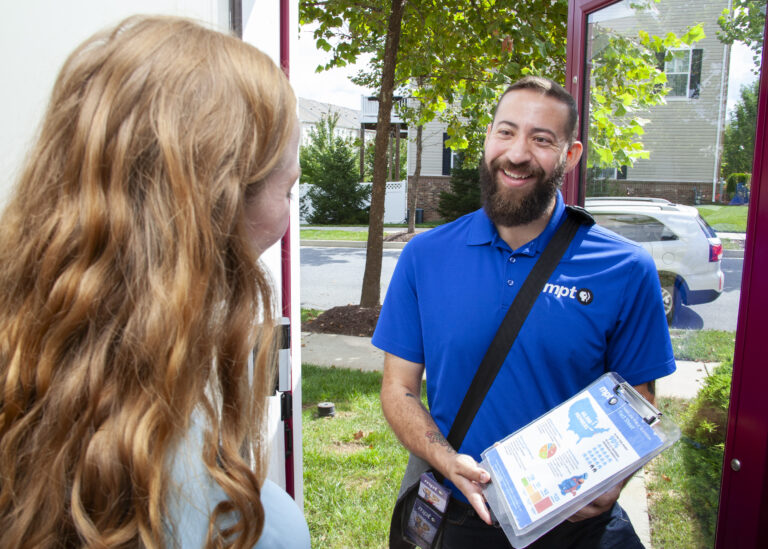
MPT launched its canvassing program in April 2025. They call their canvassers MPT membership ambassadors. Each ambassador wears a cobalt-blue shirt with the MPT logo and has their photo posted to MPT’s website. MPT strategically branded this initiative as Door-to-Door Membership – an extension of their existing membership portfolio.
Acquisition Success: Fueling the Sustainer Pipeline
Door-to-door canvassing has wildly outpaced MPT’s goals.
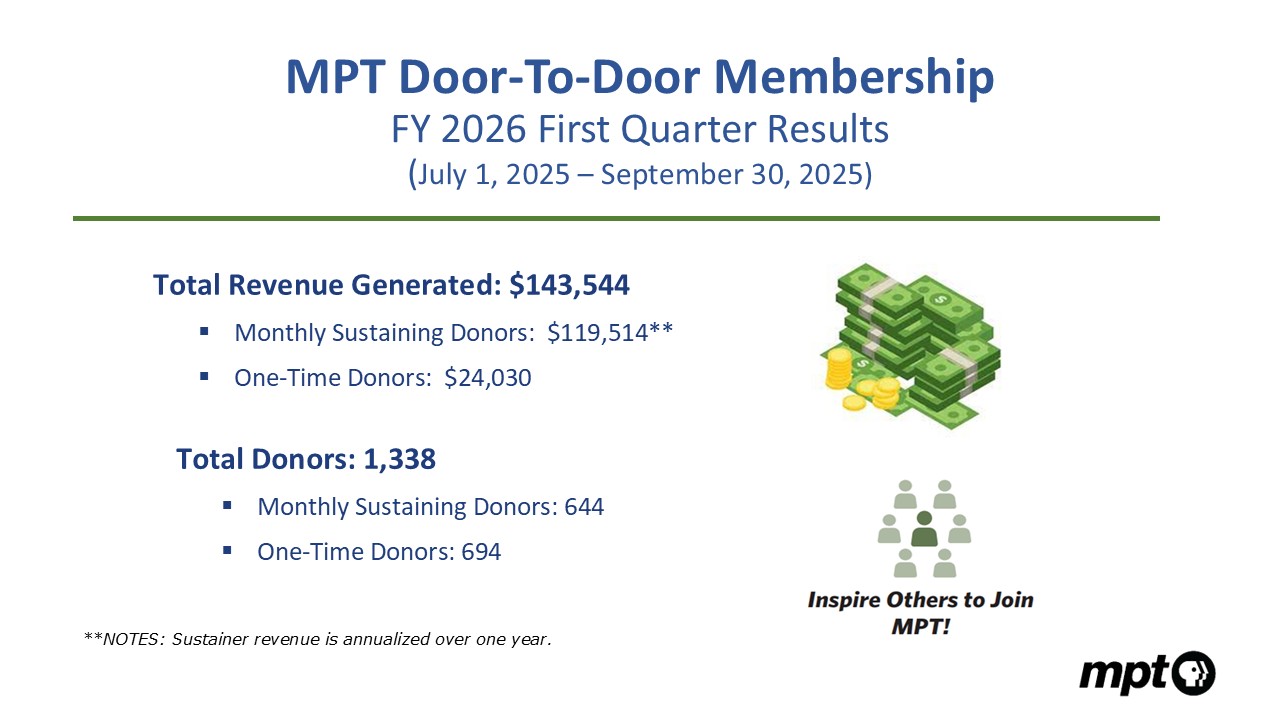
MPT set out to acquire 2000 new donors in its first year of canvassing. Within five months of launching, they’d secured 2,049 new donors. From July through September 2025 alone, canvassing yielded 1,338 new donors; about half of those (644) signed up as monthly sustainers.
Taggart says the initial startup costs for the last quarter of FY 2025 were $156,500 and came from the station’s foundation. MPT is officially a state agency, supported by a separate foundation that raises money on its behalf. MPT executives, including Turner and Taggart, had to convince the foundation’s board this was a worthwhile investment. MPT projected it would take three years for its canvassing program to fully cover operating costs annually. Now they anticipate hitting that milestone even sooner.
MPT sees its door-to-door membership program as a long-term investment in growing a pipeline of sustaining members. “We know anecdotally that these donors are younger,” says Turner.
Again, Turner was initially skeptical any of this could work. But she put a lot of stock in the guidance she received from public media colleagues who urged her and MPT to take the leap. “These were people I had built relationships with. They were the thought leaders. The go-getters. I knew them and I trusted them,” Turner says.
Once Taggart heard this, she was similarly convinced.
“Those thought leaders are the same people I rely on and highly respect,” says Taggart.
OPB: Embracing the Long Game of Acquisition
More than three thousand miles away, Oregon Public Broadcasting’s senior director of membership, Anne Ibach, was on the front lines when OPB launched its canvassing program in 2014. She didn’t have to sell the idea; OPB’s former CEO Steve Bass was a proponent. Bass also had a discretionary fund that helped cover the startup costs, which Ibach estimates were around $400,000.
“I believe wholeheartedly in investing in member acquisition,” says Ibach. “I think very few public media organizations do any kind of a significant investment in member acquisition. Especially when you get to medium and smaller organizations, they might not even be mindful of where their new members are coming from.”
OPB was able to launch its canvassing program as a special initiative without cutting or cannibalizing existing donor acquisition efforts such as direct mail. “We saw this as a new thing that we were taking on,” says Ibach.
Ibach knew that she wouldn’t see immediate results. This was a longer-term investment.
“Canvassing is not a short term thing. If you’re going to launch it and look at it after a year, it’s probably not going to look very good. It’s going to look better after two years. After three years, it’s going to start making sense.”
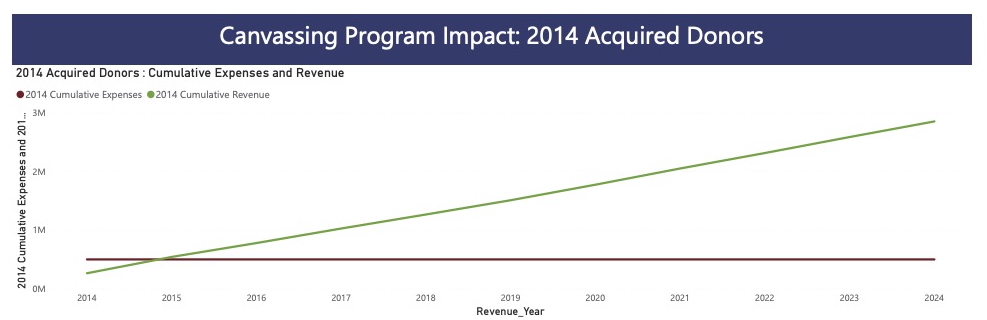
Cost to acquire donors via canvassing in 2014 vs. cumulative revenue over time of those 2014 donors.
OPB’s current annual investment in canvassing is about $650,000, and the program has been a small but mighty driver of new sustaining members.
“We focus on sustainers like crazy,” she says. It’s the main purpose of OPB’s canvassing program. Ibach emphasizes that “it’s crucial to get new members on as sustainers in the first place. That’s really the main driver of retention.”
In 2014, Ibach estimates OPB had about eight to ten thousand sustainers. Today, their sustainer base has ballooned to 122,000. Overall, 64% of OPB’s new members are sustainers. Canvassing is a significant new member acquisition source: in FY 2024, 15% of all new members were acquired via canvassing, and 52% of canvass-acquired donors become sustainers.
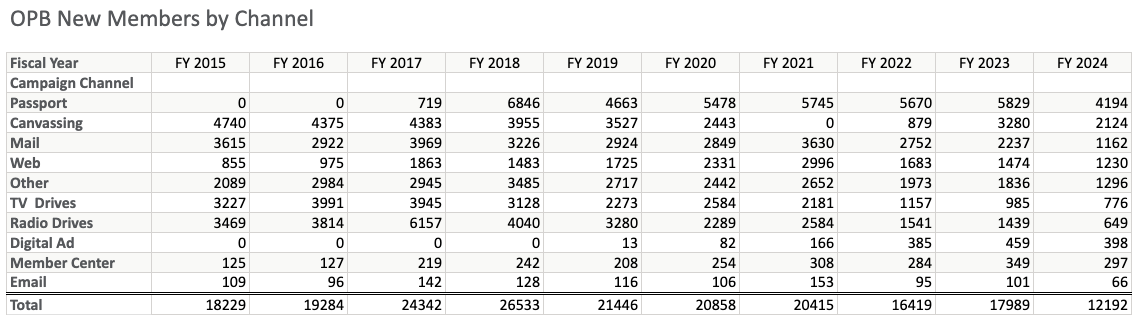
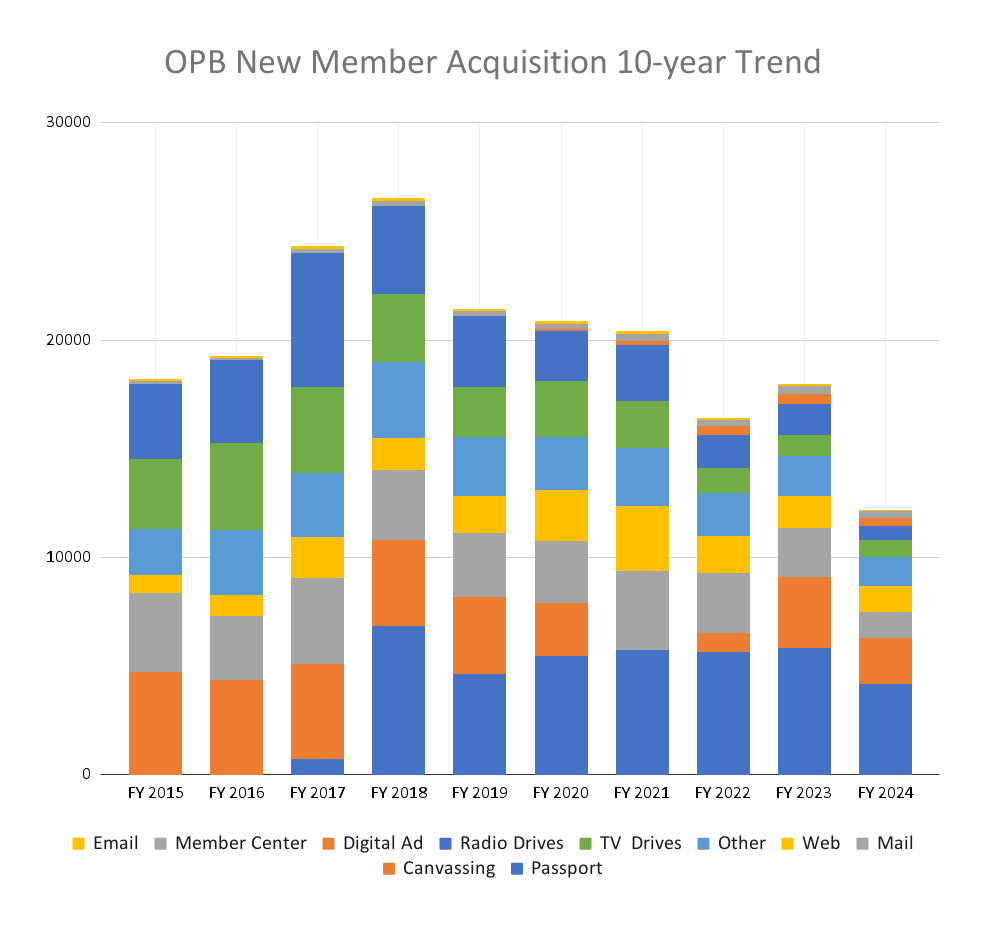
For several years, canvassing was OPB’s number two source of new members, behind PBS Passport. In FY 2025, however, Web acquisition (which increased substantially due to federal funding threats and related executive orders) surpassed canvassing, moving it to the number three source of new members. Canvassing’s impact remains huge, however. In FY25, 12% of new sustainers came through canvassing.
“In fiscal years 2023-25 canvassing outpaced direct mail. It outpaced digital. It even outpaced TV and radio drives combined,” says Ibach. “So it’s become a really important part of our overall member acquisition program.”
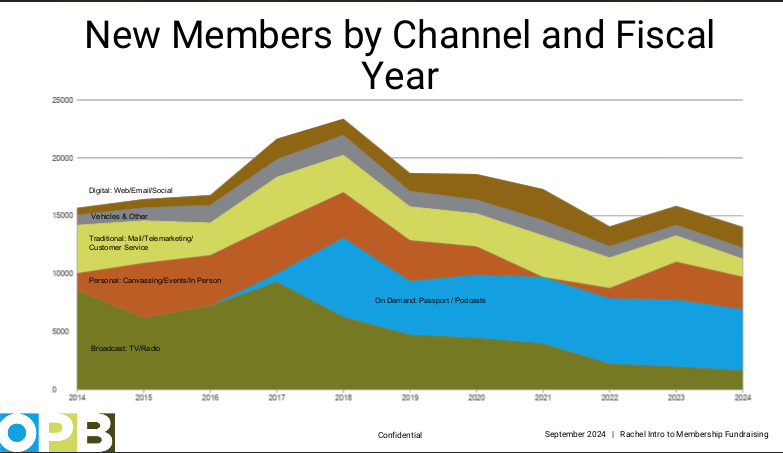
At OPB, canvassing has brought in more new members than direct mail, digital and on-air drives since FY23.
While Passport subscriptions continue to drive membership, Ibach sees it as a risky carrot, because Passport is owned and operated by PBS. OPB can promote it, but they can’t make changes to the platform or communicate with subscribers. “So yeah, it’s a big chunk of dependence,” says Ibach.
But canvassing is different. It’s a tactic that has strengthened and diversified OPB’s donor base.
“You really want to maintain all these really diverse sources of members, because you never know when one of them is going to be affected,” says Ibach.
While investing in member acquisition is crucial, Ibach emphasizes it’s just the beginning. She says you also have to be laser focused on retention. OPB’s overall retention rate is over 85%.
“If you’re making significant investments into acquisition, you should be making significant investments into retention. That’s not necessarily dollars. It’s the cost of a phone call. It’s the cost of staff time to create communications. But that retention work is really important.”
The Crucial Caveat: Why Every Test Must be Market Specific
Back on the East Coast, New York Public Radio’s senior vice president of membership Anne O’Malley, had been hearing about OPB’s success with canvassing. So she decided to investigate the idea and evaluate its feasibility. Her conclusion: it wasn’t a good fit for a residential environment like New York City where access to apartment buildings would make a door-to-door canvassing effort inherently difficult. The startup cost would also be significantly higher in New York. NYPR isn’t a dual licensee and so they can’t offer Passport memberships as an incentive. So O’Malley decided not to pursue canvassing in the end. Still, she thinks the vetting exercise was worthwhile. “Canvassing seems to be a channel that’s working for some stations in terms of new donor acquisition,” says O’Malley. She encourages other stations to do their own data-driven vetting. “It’s something you could learn about through Benchmarks and then potentially use that data to secure the funds,” she says.
Conclusion: Don’t Settle for Diminishing Returns
While canvassing as a tactic requires a significant startup investment, a culture of experimentation isn’t exclusive to organizations with large budgets. Whether you decide to pursue canvassing or something else entirely, public media organizations large and small can benefit from diversifying revenue streams and donor pools. This means making investments that have potential for a longer-term payoff and not relying on legacy tactics with diminishing returns.
Remember: you don’t always need to build from scratch. You can also use another station’s success to get buy-in and guidance. Don’t wait for the ‘perfect’ solution. Leverage your peer network, talk to Greater Public advisors about what we’re hearing across the system. We can help you identify the kind of testing that makes sense for your organization.
Contributors to this blog post

Author
More on the blog
Latest Articles



Disciplines
Popular Tags
Sustainers New Audiences Mid-Level Giving Leadership Donor Acknowledgement Digital Fundraising FCC Industry Categories Donor Cultivation Event Sponsorship Halo EffectRelated Member Content
View these related member resources and more with a Greater Public membership: